©
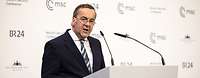
Bundeswehr/Christoph KassetteRede des Ministers: „Holding the Line: Defending Europe and Supporting Ukraine.“
- Veröffentlichungsdatum
Die Rede des Verteidigungsministers im Wortlaut.
Es gilt das gesprochene Wort!
President Nausėda,
Deputy Prime Minister Kachka,
Minister Sikorski,
Senator Slotkin,
Professor Pisarska,
Ladies and Gentlemen,
My mother was a passionate, freedom-loving politician who taught me a lot about our world.
She was born in 1933, a year that marks a profound rupture in German and European history. She lived through the Second World War, the collapse of a murderous regime. She had to endure displacement and expulsion, experienced the division of Germany and the fall of the Berlin Wall in 1989.
Like so many in her generation, she learned first-hand how quickly the tides can turn, how fragile freedom and peace can be.
This experience of fragility of the existing order shaped her life and the decisions she made as a politician.
Today, international politics is teaching us a similar lesson: Nothing can be taken for granted. Freedom is under attack around the world. The international order is crumbling. Wars and crises are on the rise across the globe.
America’s focus is shifting. With it a central building block of European security is under reconstruction.
Is that a reason for pessimism? To be frank: Having the United States provide for our security was never supposed to be the norm. It was always an exception. Naturally, exceptional arrangements never last forever. They are not meant to.
What I take from the latest US Defense Strategy and the NATO defence ministers’ meeting is a sense of realistic, pragmatic and sober optimism:
The next chapter of our partnership depends on a clear and fair distribution of responsibilities: Europe must take the lead in providing robust conventional forces and take on greater responsibility for its own neighbourhood, while the United States continues to contribute strategic and nuclear backing for the foreseeable future.
The US has made this new burden sharing very clear and Europe is acting. NATO is becoming more European so that it can remain transatlantic!
The alliance needs to make sense for all members. Even the United States cannot act all alone in today’s world of emerging great powers. It needs allies. Having more than thirty of them all united in one powerful alliance is truly unique. It makes the United States stronger than any of the other great powers and, most importantly, stronger than its adversaries.
But our alliance also needs to make sense for Europe. It depends on predictability of actions and reliability of the American commitment.
Questioning the territorial integrity and sovereignty of a NATO member state. Excluding European allies from negotiations that are crucial to the security on the continent. All this damages our alliance and strengthens our adversaries.
Let me also say a few words on Secretary Rubio’s vision for the world order: Yes, our international organisations have failed to solve many crises and conflicts.
But the answer cannot be for a great power to go it alone. That might work in the short term. But in a world of more competing great powers this will definitely not work in the long term.
There is a much better way: Reforming and reinvigorating international organisations – just as Marco Rubio pointed out this morning, too – so that they deliver what is crucial: peace and security.
We can only do that together.
Ladies and Gentlemen,
a strong and capable Alliance is particularly crucial given the many interconnected threats and uncertainties we face:
In Europe’s southern neighbourhood, we are confronted with a complex mix of fragile states and terrorism, as the recent resurgence of ISIS in Iraq has shown. It is easy but dangerous to overlook these simmering threats, considering the huge blow they can strike at both Europe’s and America’s security.
In the east, we are faced with a highly armed and aggressive military power with the world’s largest nuclear arsenal at its disposal.
Russia is driven by raw power, revisionism, and egoism. Nowhere does this become more apparent than in its brutal war of aggression against Ukraine.
Moscow is not acting alone. It is pursuing its revisionist agenda by cooperating with China, Iran, and North Korea. It is trying to use international fora such as BRICS and turn them into anti-Western blocs.
Up north, Russia and China are getting ready to project military and economic power in the Arctic. In the event of an escalation in Europe, Russia would most likely use its Northern Fleet to open a second front, cut transatlantic supply lines, and threaten both sides of the Atlantic with nuclear submarines.
Ladies and Gentlemen,
In a world of fragility, we cannot afford complacency.
This is why Germany drastically increased its defence spending. To do so, we took a huge step: we amended our constitution. This speaks volumes of how serious we are about our commitment to security and defence in and for Europe. We will reach our new defence spending target of 3.5 percent by 2029.
We reformed our military service law. This will lead to much stronger active forces and a more resilient reserve.
We are meeting NATO’s targets on investment, procurement, and readiness.
We have significantly scaled up investments in our defence industry, expanded production capacities, and streamlined our procurement processes.
Germany today is guided by determination and strength, but one thing will never change: We will not act alone. But always in close coordination with our allies. As a reliable partner.
Division is weakness, especially when facing revisionist powers. We cannot allow internal or external powers to drive a wedge into our alliance. It is unity that gives us strength.
That is why Germany is working towards building unity at the heart of NATO and at the heart of Europe.
That is why we are deploying a full, combat-ready brigade to Lithuania.
That is why we are strengthening maritime security with Canada, Norway, Denmark, and Iceland in the North Atlantic.
That is why we are now the largest supporter of Ukraine. And that is why our support for Ukraine will not waver, even as Putin’s brutal war of aggression is entering its fifth year now.
When it comes to the future of Ukraine, three points are crucial in my view:
First: We will keep looking for paths to a reliable peace, because Ukraine’s future is fundamental – not just to European security, but to global stability. We need a peace deal that safeguards both Ukraine’s and our European interests.
Second: The ball is in Putin’s court. He is the one who is dragging out negotiations and is showing no willingness to compromise. He is shifting the cost of war to his own people.
But he must not be mistaken: We will continue doing everything in our power to protect Ukraine as an independent, sovereign European nation. We will keep up the pressure – politically, economically, and militarily.
And third: We will have peace.
And when – not if – this day comes, we will have to make this peace last. We will have to shield Ukraine from any potential future aggression by Russia.
To accomplish this huge task, Ukraine needs substantial, reliable security guarantees.
It was in fact Marco Rubio, who made an important point in 2014 before the U.S. Senate.
He reminded everyone that the 1994 Budapest Memorandum did ultimately not serve the purpose of providing for Ukraine’s security. Quite the opposite: 20 years later, Russia invaded and annexed Crimea.
Therefore, our lesson for today must be: We cannot afford another paper tiger like the Budapest Memorandum.
To provide credible and reliable security guarantees, all of us - Europeans and Americans - have to deliver. Europe and Germany stand ready to play their part.
Ladies and Gentlemen,
When listening to today’s and yesterday’s speeches at this conference, I am once again reminded of my mother’s biography. She lived through the radical destruction of an international order. Because not enough people in Germany and elsewhere stood up to those who wanted to destroy and replace it with their barbarian ideology of war and suppression.
But she also witnessed the emergence of a new, stable, free and rules-based order, thanks to the dedication of those who worked to establish it. This brought peace and freedom to large parts of Europe.
There were times when we Europeans took this for granted. When we did too little to support this precious order. When we dwelled on our weakness, when we complained, when we criticized each other for inaction. And Radoslaw, we all remember your famous words about German inactivity.
The reality today is very different: Combined, European armies outnumber any other army in the world.
We are spending much more on defence than ever before. Our defence industry produces top-tier equipment. We are taking our future into our own hands in the areas of joint capability development and procurement financing.
But there is room for more – much more.
I want German and European security and defence policy to be more effective and more hard-edged.
I want Europe to be more than a strong economic force. It must develop more military power. It must take over more responsibility for its own security.
I want our actions to be better-coordinated internationally, and I want them to be more visible.
I want security to be not just a whole-of-government but a whole-of-society matter. This is key to building resilience in Europe.
I want us to be able to pursue our own interests, and to stay the course, even when the going gets tough. With the debates over Greenland, we have proven that we are capable of doing so.
We have to reform and harden our international organisations so that they can better deliver. We have to do more to strengthen our institutions and conventions. With both our traditional and potential new partners, and – if need be – just us Europeans.
In a less reliable world, we need more reliable politics. Our strongest currency is reliability.
In times of fragility and transition, when few things can be taken for granted, I want Europe to be a reliable anchor for other nations. A continent supporting and shaping an international order as the basis for peace and freedom. And – equally important: Providing for its own security.
Let us show what we Europeans are capable of. Thank you!