©
Bundeswehr/Christoph Kassette
KategorieNews
Joint Statement of Boris Pistorius and Richard Marles
- Date of publication
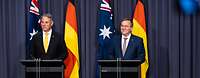
In Canberra, Australia, Federal Minister of Defence Boris Pistorius and Australia's Deputy Prime Minister and Minister of Defence Richard Marles issued a joint statement on the international security situation. They focused particularly on the conflicts and tensions in Ukraine, the Middle East and the South China Sea. Both sides reaffirmed that conflicts should be resolved peacefully and in accordance with international law. The ministers also agreed on the need to address geostrategic challenges through enhanced defense cooperation between the two countries.
Joint Statement
- The Deputy Prime Minister of Australia, the Honourable Richard Marles MP, welcomed the Federal Minister of Defence of Germany, Mr Boris Pistorius, to Canberra for his first official visit to Australia.
- Ministers acknowledged the deteriorating international security environment. They reiterated unequivocal condemnation of Russia’s illegal war of aggression against Ukraine, and reaffirmed steadfast commitment to supporting Ukraine. Underscoring the importance of an Indo-Pacific where freedom of navigation and overflight is respected and upheld, Ministers shared concerns about increasing tensions and the intensification of destabilising and dangerous activities in the South China Sea that endanger lives and risk escalation. They reiterated that disputes should be settled peacefully in accordance with international law, and reaffirmed the 2016 South China Sea Arbitral Award as final and binding on the parties. They underscored the importance of peace and stability across the Taiwan Strait and reaffirmed their shared opposition to any unilateral action to change the status quo. Against the backdrop of expanding conflict and escalating humanitarian impacts in the Middle East, Australia and Germany called on all parties to uphold international law and protect civilian life. Ministers condemned unequivocally Iran’s dangerous escalations, particularly in and around the Strait of Hormuz, its attacks against merchant vessels, and threats of further attacks that have transformed this critical shipping lane into a theatre of coercion and conflict.
- Ministers recognised that these significant geostrategic challenges underscored the importance of strengthening defence cooperation between our countries. They further acknowledged the need to contribute to military activities that uphold international security and deter threats to our shared strategic interests. Ministers committed to exploring opportunities to enhance how our militaries exercise and cooperate, including considering mechanisms to facilitate the movement of defence personnel and equipment through our respective countries and remove unnecessary barriers to operational collaboration. As such, Ministers agreed to initiate discussions on establishing a Status of Forces Agreement. Acknowledging our shared security interests are no longer bound by geography, Ministers also agreed to explore opportunities for greater cooperation in the space domain.
- Affirming the importance of the trusted defence industrial collaboration between our countries, Ministers undertook to explore how to streamline information sharing and bolster industry partnerships. This will deliver both Australia and Germany greater supply chain resilience and economic opportunity.
- Ministers affirmed the strength of our countries’ shared interests, built upon a commitment to international security and prosperity achieved through respect for the international rules based order. They undertook to work with their Foreign Minister counterparts towards futures dialogues to harness the strategic opportunities presented by our alignment of principles and priorities.