

The Hardthöhe
The Hardthöhe in Bonn has been the official seat of the Federal Ministry of De-fence since 1955.

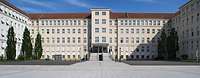
The Bendlerblock is one of Berlin’s key sites in terms of 20th-century German history. It was here, on 20 July 1944, that Colonel Graf von Stauffenberg attempted to overthrow the Nazi dictatorship. That same evening, he and fellow conspirators were executed in the inner courtyard. Today, the Bendlerblock is both the site of a resistance memorial and the defence ministry’s second official seat.
The Bendlerblock, which takes its name from Bendlerstrasse (now Stauffenbergstrasse) near the Tiergarten and Landwehr Canal, was built between 1911 and 1914 for the Imperial Naval Office. After World War I, it housed the Reich Ministry of Defence and the Army Command. During the Third Reich, it was the headquarters of the Army Office and the Reserve Army. The Bendlerblock assumed its present shape in 1938 after undergoing extensive enlargement.
It was in the Bendlerblock that the nucleus of the military resistance against Adolf Hitler formed in the early 1940s. One of the inner circle figures was Colonel Claus Schenk Graf von Stauffenberg. As Chief of Staff of the General Army Office, he had direct access to Hitler, and it was he who carried out the assassination attempt on 20 July 1944.
On the same day, he and his conspirators in the Bendlerblock tried to launch a coup d’état. Hitler survived the attempt on his life, suffering only minor injuries. That same evening, Stauffenberg and other senior resistance members were executed by firing squad in the inner courtyard of the Bendlerblock.
The Hardthöhe in Bonn has been the official seat of the Federal Ministry of De-fence since 1955.
When the war ended in 1945, reconstruction work began on the destroyed building complex. From the 1950s until German reunification, the building was used by a variety of government agencies. Since 2 September 1993, the Bendlerblock has been the second official seat of the Ministry of Defence – the first being the Hardthöhe in Bonn. Having an official seat in Berlin ensures that the ministry’s Executive Staff and directorates-general are in close proximity to the political decision-making bodies in the German capital.
The resistance fighters and their attempted coup are commemorated by the German Resistance Memorial Centre in what used to be the Army High Command headquarters. A permanent exhibition entitled “Resistance against National Socialism” documents the breadth and complexity of the fight against the Nazi dictatorship. In the inner courtyard, the site of the executions, there is a statue by the sculptor Richard Scheibe – a memorial to the resistance fighters who were killed.

The southern front of the building overlooking Landwehr Canal

Main entrance for staff and visitors of the Bendlerblock on Stauffenbergstraße

The impressive atrium extends over four floors

Image(s) of the resistance fighters surrounding Stauffenberg

The parade grounds connect the Bendlerblock with the Bundeswehr Memorial (on the far right)

The Memorial west of the Bendlerblock

This shot shows large parts of the building complex

Memorial for the victims of 20 July 1944 in the courtyard of the Bendlerblock