©
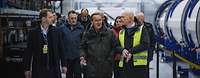
Bundeswehr/Maximilian SchulzPartner nation in the High North: Pistorius intensifies cooperation with Norway
- Date of publication
Minister of Defence Boris Pistorius accompanied Federal Chancellor Friedrich Merz to Norway on 12 and 13 March 2026. In Andøya, the Minister’s agenda included meetings with Norway’s Prime Minister Jonas Gahr Støre and Defence Minister Tore O. Sandvik. The programme was rounded off by a visit to the Cold Response military exercise in Bardufoss, which was also attended by representatives from Canada.
The German-Norwegian partnership is characterised by intensive exercise cooperation and close collaboration on armaments, capability development as well as supporting Ukraine. It is based in particular on a common threat perception. Especially regarding the situation in the High North, the North Atlantic and the Arctic, Norway and Germany see each other as important partners. The signing of the German-Norwegian defence agreement ‘Hansa’ on the sidelines of the Munich Security Conference in 2026 made this clear and laid the foundation for an even more intensive cooperation – especially in the areas of space-based reconnaissance and maritime security, but also in the form of joint operations and armaments projects.
Space: intensified German-Norwegian cooperation
One joint future project is the German-Norwegian cooperation in space. During a visit to Andøya Spaceport, Minister Pistorius underlined that Norway is a key partner for Germany in the space domain, due to its facilities and many years of experience. The Andøya Space Centre (ASC) on the Norwegian island of the same name serves as a strategic gateway to space, enabling an independent European launch capacity for small satellites. The German-Norwegian cooperation reduces dependence on non-European launch sites and the often busy European space station in Kourou.
According to the Minister, Andøya is just one example of the close cooperation in space, which he would like to further develop – for instance with a joint satellite constellation for imaging reconnaissance. Referring to the first Space Security Strategy of the German government, Pistorius pointed out that it was important to jointly build capabilities and think about their resilience, also in this innovative and rapidly developing domain. The Norwegian and German industries were already pushing forward with joint technology projects in the space sector.
German-Norwegian submarine cooperation
The talks in Norway focused on the intended cooperation with Canada on the U212CD#2 submarine project. In Andøya, a meeting was therefore also held with Canada’s Prime Minister Mark Carney. Canada intends to procure a replacement for four submarines by 2035. The German-Norwegian offer for a possible Canadian participation in the U212CD#2 submarine cooperation was presented to Canada in Ottawa on 2 March 2026. Pistorius underlined in Norway that all requirements had already been met for Canada to join the submarine project as an equal partner.
| The U212 CD (Common Design) submarine project is a German-Norwegian cooperation for the procurement of submarines. They are based on Type 212A but are significantly larger (about 73 metres), quieter and equipped with improved propulsion and sensor systems. The Type 212A submarines are the most modern in the world. Their main task is to engage targets above and below the water surface. Reconnaissance and the deployment of combat swimmers are also part of their operational spectrum. Germany and Norway have each ordered six of these submarines. The project makes a valuable contribution to strengthening NATO’s defence and deterrence capabilities. |
|---|
In Norway, Pistorius once again highlighted the advantages of a joint submarine fleet regarding maritime security in the North Atlantic. According to the Minister, it is only through interoperability, joint maintenance and training that safety can be sustainably guaranteed and developed there over decades. In the spirit of the Maritime Security Partnership, he expressly welcomed the cooperation being expanded to include Canada. Pistorius also welcomed the fact that Norway increased the number of submarines ordered from four to six, which he described as another strong signal to Canada.
The Minister said that Russia, and in particular Russian submarines, are a concrete threat that the partners must face together. He added that a joint state-of-the-art submarine fleet with high availability is an important security guarantor and a credible deterrent.
Cold Response: defending NATO’s northern flank
The participation of Bundeswehr forces in the Cold Response 2026 exercise as part of NATO’s ‘Arctic Sentry’ activity is another sign of Germany’s commitment in the High North. The melting Arctic is uncovering new sea routes towards NATO territory, which now require even more protection than before. Since 13 February 2026, NATO has therefore been conducting the enhanced Vigilance Activity (eVA) ‘Arctic Sentry’. The main objective is to permanently increase the presence in the region and to gain an improved situation picture.
Together with the Canadian delegation, Pistorius and his Norwegian counterpart, Tore O. Sandvik, visited the Cold Response exercise, which also included the German U35 submarine in operation. The U35 is a Type 212A submarine that serves as the basis for the new joint Type 212 CD.
Cold Response 2026 is the largest Norwegian military exercise of the year and is intended to strengthen the operational readiness of the Allies. As one of the key NATO partners, Germany is participating with approximately 1,800 troops. The exercise takes place in extreme Arctic conditions.
Author: Lara Finke