


You are on this page: Home > Security Policy > Information > Documents > Defence Policy Guidelines 2003

Defence Policy Guidelines 2003

Berlin, 21.05.2003.
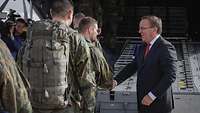
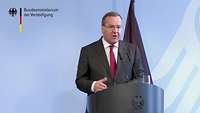
With the Defence Policy Guidelines, Federal Minister of Defence Peter Struck set the course for Germany’s security policy. On 21 May 2003 he presented the Defence Policy Guidelines in Berlin.

Minister Struck während der Bundespressekonferenz

The changed security environment in Europe and throughout the world called for reorientation of Germany’s security and defence policy. Traditional national defence has become less important, whereas the response to international conflicts, asymmetric threats, terrorism and weapons of mass destruction are now the focus of German security issues.

This led to a change in the tasks of the Bundeswehr. The Bundeswehr will in future focus on conflict prevention and crisis management operations. Together with its allies and partners in the EU and in NATO and integrated into the multinational environment of the UN and the OSCE, Germany will increasingly concentrate on these tasks.

Such operations will have a bearing on the future structure of the Bundeswehr. “Traditional national defence can no longer primarily determine the structures and capabilities of the Bundeswehr, for there is no apparent conventional threat to German territory at present and in the foreseeable future,” Federal Minister of Defence Dr. Peter Struck underlined when presenting the Defence Policy Guidelines during the Federal Press Conference. However, it must be ensured that the ability to conduct national defence operations can be reconstituted within a “foreseeable, albeit prolonged, period of time”. Struck expressly ruled out pre-emptive operations.

According to the Defence Policy Guidelines, the core military capabilities include command and control, intelligence collection and reconnaissance, mobility, effective engagement, support and sustainability, survivability and protection.
Universal conscription in an adapted form remains an indispensable requirement for the operational readiness, effectiveness and economic efficiency of the Bundeswehr.

Struck announced that he intended to bring about a decision on the retention of conscription within the Social Democratic Party before the summer recess. This is to be followed by discussion with the Green coalition partner; a final decision is to be expected by the end of the year. The coalition agreements entered into by the Social Democrats and the Greens provide for the review of the provisions of the German Basic Law relative to armed forces and of the duration of military service before the end of this legislative term. Struck himself is fully committed to conscription: The abolition of conscription in France, for instance, led to a considerable increase in costs and a rapid decrease in public interest in the armed forces. According to Struck, a decision on the future duration and organisation of conscription has not yet been made. However, the Defence Minister dismissed proposals for shortening the term of military service to about three months as “absurd”.

The reorientation of the Bundeswehr entails the disbandment of units. This applies to the surface-to-air missile groups in Schöneck, Burbach (both groups are to be disbanded by late 2004), Bad Arolsen, Möhnesee, Eydelstedt, Großenkneten (these are to disbanded after 2004) and in Leipheim (to be disbanded by late 2005). By the end of 2005 the naval air wing in Tarp-Eggebek and the German Air Force fighter bomber wing (TORNADO) in Schortens will also be disbanded. Struck stated that the closure of further bases and installations will be “inevitable”.

The Defence Policy Guidelines are drawn up by the Planning Staff of the Federal Ministry of Defence and serve as basic parameters for further planning documents such as the “Bundeswehr Concept” or the Bundeswehr Plan prepared by the Chief of Staff, Bundeswehr. The previous Defence Policy Guidelines date from 1992, prior to which two versions had been published in 1972 and in 1979.

back to top


FußFzeile

Up

Current as of 8/14/12 | Author: 


http://www.bmvg.de/portal/poc/bmvg?uri=ci%3Abw.bmvg.sicherheitspolitik.angebote.dokumente&de.conet.contentintegrator.portlet.current.id=01DB010000000001%7C64WS4R915MMIS