
"Our job isn't finished yet." – An interview with Major General Hans-Werner Fritz
Mazar-e-Sharif, 29.12.2010.
In June 2010, Major General Hans-Werner Fritz took over ISAF's Regional Command North (RC North) in Afghanistan. Approximately 11,000 troops from 16 nations are under his command. In an interview with bmvg.de he talks about the change of strategy in Afghanistan and takes a look back over the past year.

General, this year a change of strategy, as agreed on in February 2010, has occurred in Afghanistan. What exactly has changed here at RC North?
As you will know, the change of strategy mainly refers to the lines of operation, including security, good governance and development. This has directly affected us in the way that RC North has been transformed into a two-star headquarters and that the civilian component within this headquarters has been substantially upgraded.
This is important insofar as this networked approach makes it necessary to think ahead while planning a military operation: How can we further pursue this line of operation with regard to good governance and administration in conjunction with development. Thus, it is essential to get small-scale projects on their way as soon as possible and then consider opportunities for continuing along this line with medium- and long-term projects.
ISAF forces have been significantly reinforced here in northern Afghanistan. What capabilities have been added? In what respect can you operate differently now?
Over the past six months we have more than doubled the number of forces in the area of RC North. I have now about 5,000 German troops under my command, plus 5,000 soldiers from the U.S. and some 1,500 from other nations. This gives me tremendous opportunities.
The Americans, for instance, have contributed the bulk of an attack helicopter brigade. Given the dimensions of our area of operations, which is about half the size of Germany, this is, of course, an enormous capability we have gained. It means that I am now in a position to conduct operations far more intensely, allowing me to move into regions or areas that we previously had no access to.
We have also improved at the national level. The operational readiness of the self-propelled howitzers, as well as that of Heron, has significantly enhanced the spectrum of our capabilities. In addition, the two training and protection battalions are now directly assigned to me. To cut a long story short: The range of assets and options available to me now has considerably broadened.

How is cooperation with the international forces, especially the U.S. troops?
I am most satisfied. We always have to keep in mind that this is the first time that U.S. forces are led by a German commander while on operations. It is a completely new experience, and I would like to pay my heart-felt compliments to the American comrades, as well as to all the other soldiers: they are doing a great job. Cooperation is excellent. Everyone contributes to the best of their abilities and with whatever resources they have available. In this way we have achieved a very good mix which has definitely brought us quite a bit closer to our common goal.
One topical issue is partnering – an emotive term that has frequently been criticised. Has this new concept paid off in your opinion?
Partnering – that is the direct cooperation with our Afghan friends and partners – is an area where we have made great progress. It is thus difficult for me to understand the criticism that has occasionally been expressed in the media. First, the Afghans are willing to cooperate, and second, they have a great ability to learn. It is quite remarkable to see how we are currently working together with the Afghans on specific operations, where combat activities are involved, making them a matter of life and death.
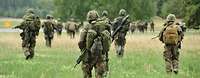
We plan all operations jointly with the Afghans, from the corps level here at the Regional Command through the brigade level down to the battalion and company levels. Our servicemembers are literally fighting shoulder to shoulder with the Afghans. Therefore, I think that partnering is the right way, especially since it is their country we are fighting in and it is eventually their security and their future that is at stake. We must always keep one thing in mind: This is where two completely different cultures meet. It starts with the language and continues with certain patterns of behaviour, but ultimately it all comes down to trust. And this trust has been achieved.

How did the insurgents respond to the changed approach and the increased pressure brought to bear by the ISAF forces?
I think they do feel the pressure. It is my firm belief that we are reaching a culminating point, as far as the security situation is concerned. What I am saying is that the insurgents have come to understand that we are really going after them. We can tell this from many of their responses: Their actions are becoming increasingly more aggressive, and also more desperate. There was politically motivated murder at a mosque during a Friday prayer. If the Taliban still try to tell people that they are friends of the Muslims, I say that they won't be able to convey their message.
So they are under enormous pressure. This also has a positive effect: As you will know, we have launched what is referred to as integration programme. And many of the Taliban now put down their weapons, saying, "We've had enough. It's over. We surrender." We want back into society. So what we have is a combination of building up military pressure and reaching out our hand, saying, Welcome back to society if you are ready to put your weapons down." That is exactly the mix we need. Those are the right tactics.
Looking back at 2010, since you took over as Regional Commander North, how would you assess what has been accomplished so far?
Our record is positive. There is even reason to be moderately optimistic, but our job isn't finished yet. There are still tough weeks and months ahead. I believe that the year 2011 will be a crucial one. As far as success is concerned, 2010 was a satisfying year.
What always deeply affects and saddens me as a multinational commander are the unfortunately very large – number of wounded soldiers and, of course, our comrades killed in action. After all, there are not only German soldiers who lose their lives. There are Americans, Hungarians, Norwegians and Swedish as well. I am sad to say that there are many of them. And when I say that I also expressly refer to all the Afghan soldiers and police officers who lose their lives.
And still: I can, in fact we can, be extremely proud of what we accomplished. I wish all troops deployed in the area of Regional Command North a successful accomplishment of their mission and a safe return to their families and friends.
The interview was conducted by Jan C. Rippl.